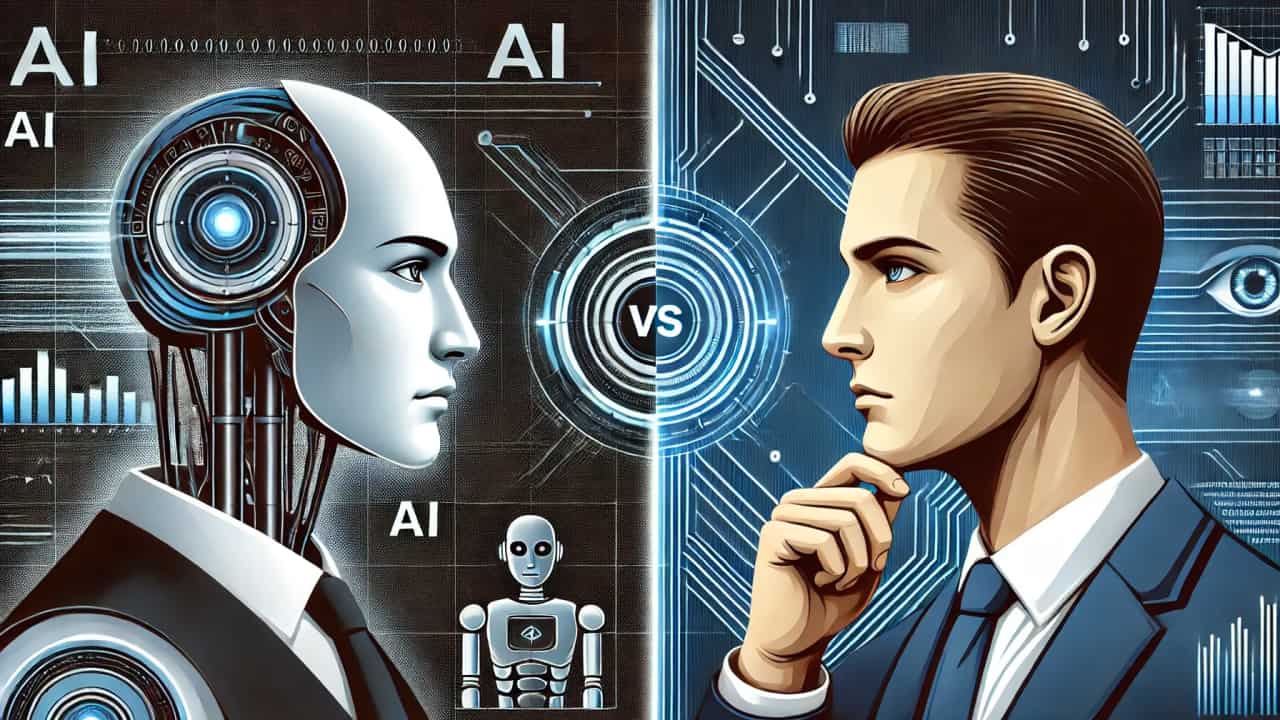
The rise of artificial intelligence has ignited one of the most consequential debates of our era: will machines take our jobs? The short answer is nuanced — AI will not eliminate work, but it will fundamentally reshape it. Over the next decade, entire categories of tasks will be automated, some professions will shrink dramatically, and entirely new roles will emerge that do not yet have names. Understanding which jobs are most vulnerable — and which are most resilient — is no longer a topic for economists and futurists. It is a survival guide for every professional alive today.
The Scope of Disruption
The scale of AI’s impact on employment is unprecedented in its speed, if not its nature. The World Economic Forum projects that by 2030, AI and automation will displace approximately 85 million jobs globally — but will simultaneously create 97 million new ones, resulting in a net gain of around 12 million positions. The critical nuance is that the jobs being created are not the same as the jobs being destroyed. They require different skills, different mindsets, and in many cases, entirely different educational backgrounds.
What makes today’s AI wave particularly disruptive is its reach. Previous waves of automation — the Industrial Revolution, the computerization of the 1980s and 1990s — primarily threatened manual, blue-collar work. The current AI revolution is different: it is coming for white-collar, knowledge-based work just as forcefully. Lawyers, accountants, radiologists, financial analysts, and even software developers are feeling the pressure of tools that can replicate core elements of their work at a fraction of the cost and time.
Jobs Most at Risk: High Automation Probability
Not all jobs face equal threat. The roles most vulnerable to AI displacement share common characteristics: they involve repetitive, rule-based tasks; they operate on structured data; they follow predictable, documentable processes; and they do not fundamentally require human empathy, judgment, or physical dexterity in unpredictable environments.
Data Entry and Administrative Roles
Data entry clerks, bookkeepers, and administrative assistants performing routine scheduling, filing, and form-processing tasks are among the most exposed workers in the coming decade. AI tools can already extract, categorize, and process structured data with near-perfect accuracy and at superhuman speed. Tools like Zapier, Microsoft Power Automate, and specialized RPA (Robotic Process Automation) platforms have been automating these workflows since the early 2020s, and the pace is accelerating.
Routine Customer Service Agents
As explored in the world of AI customer service platforms, AI agents can now autonomously resolve up to 80% of routine customer inquiries. Tier-1 customer service roles — the ones answering the same 50 questions day after day — are being rapidly absorbed by intelligent chatbots and virtual agents. This does not mean customer service employment disappears entirely; it means the composition shifts dramatically toward higher-skill roles managing AI systems and handling genuinely complex, emotionally charged customer situations.
Paralegal and Legal Document Review
AI tools trained on legal language can review thousands of contracts, flag anomalies, and extract key clauses faster and more accurately than any human paralegal. Law firms globally are already deploying AI for due diligence, contract analysis, and legal research. While the role of the lawyer — with its strategic judgment, courtroom advocacy, and client relationship management — remains irreplaceable, the volume of paralegals and junior associates needed to perform document-heavy tasks is shrinking.
Basic Financial Analysis and Accounting
Routine bookkeeping, tax preparation for standard cases, and basic financial report generation are all highly susceptible to AI automation. Platforms now generate financial summaries, flag anomalies in spending patterns, reconcile accounts, and produce audit-ready documentation with minimal human input. Senior financial roles involving strategic advisory, M&A analysis, and complex risk management remain far more secure.
Transportation and Logistics Roles
Long-haul truck driving, warehouse picking, and delivery routing are under increasing pressure from autonomous vehicle technology and AI-powered logistics optimization. While full autonomy at scale is still evolving, the trajectory is clear. Amazon, Walmart, and major logistics operators are aggressively deploying robotic systems in fulfillment centers, reducing the per-unit need for human labor in these environments.
Jobs Most Resilient: What AI Cannot Easily Replace
The roles best positioned to survive — and thrive — over the next decade share a different set of characteristics: they require genuine human creativity, complex social and emotional intelligence, physical adaptability in unstructured environments, ethical judgment, or the ability to synthesize ambiguous, incomplete information into novel decisions.
Healthcare Professionals with Human Touch
Doctors, nurses, therapists, and social workers occupy a particularly resilient position. While AI is transforming diagnostics — reading medical images, predicting disease progression, and accelerating drug discovery — the human dimensions of healthcare are irreducibly important. A patient receiving a cancer diagnosis needs a compassionate physician who can explain prognosis, answer emotional questions, and navigate family dynamics. A nurse in an ICU must make split-second decisions in chaotic, unstructured environments that no robot in 2026 can reliably replicate.
Creative Professionals and Artists
True creativity — the kind that reflects lived experience, cultural context, emotional truth, and original vision — remains a deeply human capacity. While generative AI can produce competent images, music, and text, it synthesizes from what already exists. The artists, writers, filmmakers, and designers who will thrive are those who use AI as a powerful tool while bringing irreplaceable human perspective, cultural resonance, and authentic voice to their work. The market for genuine human creativity is not shrinking — it is actually growing more valuable as AI-generated content floods digital channels.
Skilled Trades and Technical Specialists
Electricians, plumbers, HVAC technicians, construction workers, and mechanical repair specialists are far more secure than many office workers assume. These roles require physical dexterity, problem-solving in unpredictable environments, and on-the-spot decision-making that is extraordinarily difficult to automate. Humanoid robots are advancing, but the real-world complexity of rewiring a century-old building or diagnosing a custom HVAC failure remains beyond reliable AI deployment for the foreseeable future. Many countries are already experiencing skilled trades shortages, suggesting these professions will remain high-demand and well-compensated.
Teachers and Educational Leaders
Education, at its best, is not the transmission of information — it is human development. Inspiring curiosity, nurturing confidence, navigating the social dynamics of a classroom, mentoring struggling students, and building relationships that shape lives are functions rooted in human connection. AI tutoring tools are valuable supplements, but the evidence consistently shows that human teachers play irreplaceable roles in motivation, social-emotional learning, and creating environments where students take intellectual risks.
AI Managers and Prompt Engineers
Ironically, one of the fastest-growing job categories of the next decade is directly created by AI itself. Organizations deploying AI systems need humans to oversee, evaluate, audit, and improve them. Roles like AI trainer, prompt engineer, AI ethics officer, and machine learning operations specialist are in high demand and growing. These professionals bridge the gap between raw AI capability and responsible, effective business deployment — a function that requires both technical literacy and human judgment.
The Middle Ground: Roles That Will Evolve, Not Disappear
The most nuanced category is the large middle ground — jobs that will not disappear but will transform so significantly that professionals who refuse to adapt will be displaced, while those who embrace change will thrive.
Marketing and Sales professionals who can leverage AI tools for audience targeting, content generation, and pipeline automation while applying human creativity and relationship-building skills will become far more productive and valuable. Those who resist AI adoption will be outcompeted by smaller teams using AI as a force multiplier.
Software developers face a fascinating paradox. AI coding tools like GitHub Copilot are automating significant portions of routine development work — yet demand for software engineers who can architect complex systems, define product vision, and oversee AI-generated code remains robust. The developer of 2030 will write less boilerplate code and spend more time on system design, problem definition, and AI oversight.
Journalists and content creators who use AI for research, first drafts, and SEO optimization while focusing their human energy on investigative depth, exclusive sourcing, and distinctive voice will outperform both pure AI content and colleagues who reject these tools entirely.
The Reskilling Imperative
The central challenge of the AI employment transition is not technological — it is human. The workers most threatened by automation are often the least equipped to transition into new roles, due to limited access to education, financial resources, or geographic mobility. Governments, educational institutions, and corporations all bear responsibility for closing this gap.
The skills that will hold their value across virtually every profession over the next decade are:
- Critical thinking and complex problem-solving — the ability to tackle novel, ill-defined problems
- Emotional intelligence and empathy — essential for management, healthcare, education, and sales
- AI literacy — understanding how to work with, evaluate, and direct AI systems
- Creativity and original ideation — generating genuinely new ideas, not just remixing existing ones
- Ethical reasoning — making judgment calls that reflect human values in ambiguous situations
A New Social Contract for Work
The next decade will not produce a world without work. It will produce a world where the nature of work is profoundly different — where routine cognitive and manual tasks are increasingly machine-handled, and the uniquely human dimensions of imagination, connection, leadership, and moral judgment become the defining currency of professional value.
The workers who will thrive are not those who compete with AI at its own game. They are those who embrace AI as a collaborator, double down on irreducibly human skills, and position themselves at the intersection of human wisdom and machine intelligence. That intersection — not any single job title or industry — is the most secure address in the labor market of 2030 and beyond.